Every year, thousands of students receive their International Baccalaureate (IB) results and, although many achieve their goals, others wonder what options they have if their final grade is not what they expected.
The good news is that the International Baccalaureate allows students to retake their exams through what is known as a Retake. In this guide, we explain how it works, who can do it, and when it is worth retaking the exams.
What is an IB Retake?
A Retake means sitting one or more International Baccalaureate exams again with the aim of improving the grade obtained in a previous examination session.
It is not necessary to repeat the entire programme or complete the two years of the Diploma again. Students can retake only the subjects they wish to improve, while still following the IB and school regulations.
Who can take an IB Retake?
Any student who has previously completed the Diploma Programme can request a Retake through an IB World School.
Many students choose this option when:
- They did not achieve the Diploma.
- They need to improve their grade to meet university admission requirements.
- They want to improve their result in a specific subject such as Chemistry, Physics, or Mathematics.
When can you retake IB exams?
The IB holds two official examination sessions each year:
- May
- November
Not all schools offer both examination sessions, so it is advisable to check with the school where you will register.
Do you have to retake all your subjects?
No.
One of the advantages of the system is that you can retake only the subjects you want to improve.
For example, if you achieved good grades in most subjects but need to improve your Chemistry HL grade to gain admission to a university degree, you can focus all your preparation on that subject.
Do you also have to repeat the Internal Assessment (IA)?
It depends on the circumstances.
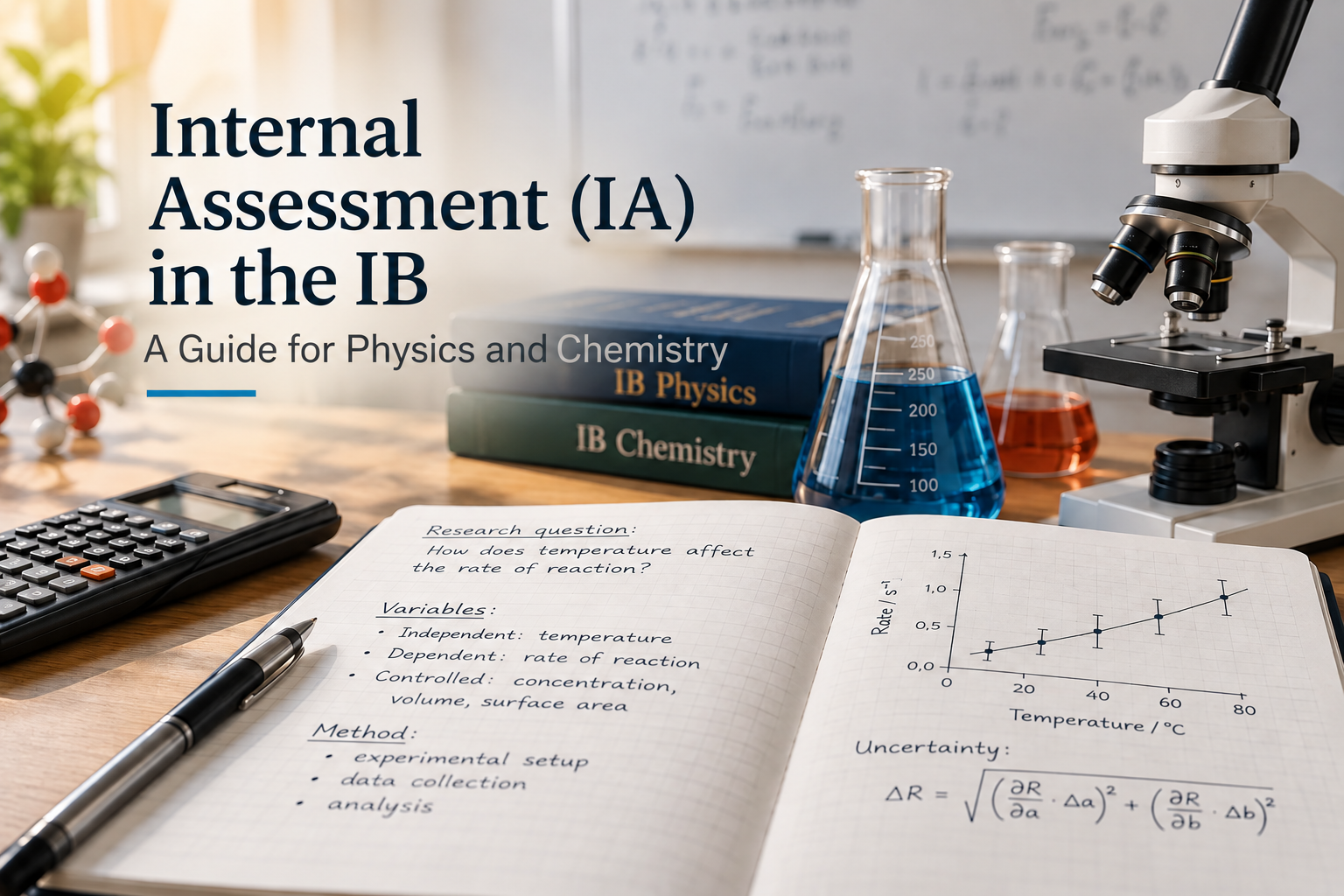
In many cases, the Internal Assessment (IA) that was previously completed can be retained and combined with the new exam grade. However, there are situations in which it is possible to submit a new IA to improve its grade, provided the school authorises it and the requirements established by the IB are met.
For this reason, it is always advisable to check the current regulations and speak to your school’s Diploma Programme Coordinator.
Is an IB Retake worth it?
The answer depends on your goals.
It can be an excellent option if:
- You need to improve your grade to gain admission to a university.
- You were close to achieving the Diploma.
- You know you can make a significant improvement with better preparation.
Many students manage to increase their score by one or several points simply because they already know the exam format and can prepare for the examination session with a much more efficient strategy.
How to prepare for an IB Retake successfully
A common mistake is studying in exactly the same way as the first time.
For a Retake, the most important thing is to identify what went wrong previously.
Some recommendations include:
- Analyse the results obtained in each Paper.
- Practise with official past papers.
- Focus on the topics that cause the most difficulties.
- Become familiar with the mark schemes used by the IB.
- Set a realistic study schedule.
In many cases, a few weeks of well-focused preparation can produce better results than months of unstructured study.
Do you need help preparing for your Retake?
If you are going to retake your International Baccalaureate exams, personalised preparation can make a difference.
I work with students studying IB Chemistry, Physics, and MAA, at both SL and HL, helping them identify their weaknesses, prepare for the different Papers, and approach the examination session with a strategy tailored to their goals.
If you would like to discuss your situation and design a personalised study plan, you can book a first consultation.