Starting the International Baccalaureate can be quite overwhelming. During the first few weeks, you’ll come across names and concepts that you may never have heard before: HL, SL, TOK, CAS, Extended Essay, Internal Assessment, predicted grades…
And, on top of that, the assessment system is different from many other school programmes.
The good news is that you don’t need to understand everything about how the IB works from day one. What matters during Year 1 is understanding how the programme is organised, what is expected of you, and, above all, how to organise yourself from the beginning.
In this guide, we’ll explain how the International Baccalaureate works and what you should keep in mind when starting Year 1 of the IB.
What is the International Baccalaureate?
The Diploma Programme (IBDP) is a two-year educational programme normally aimed at students aged between 16 and 19.
Unlike a traditional school programme, the IB is not simply about passing final exams. The programme combines:
- The study of six subjects.
- External assessments.
- Internal assessments and coursework.
- Theory of Knowledge (TOK).
- The Extended Essay.
- The CAS programme (Creativity, Activity, Service).
Therefore, one of the first things a Year 1 IB student discovers is that studying for exams alone is not enough.
And this has an important consequence: organisation throughout the two years is essential.
What subjects do you study in the IB?
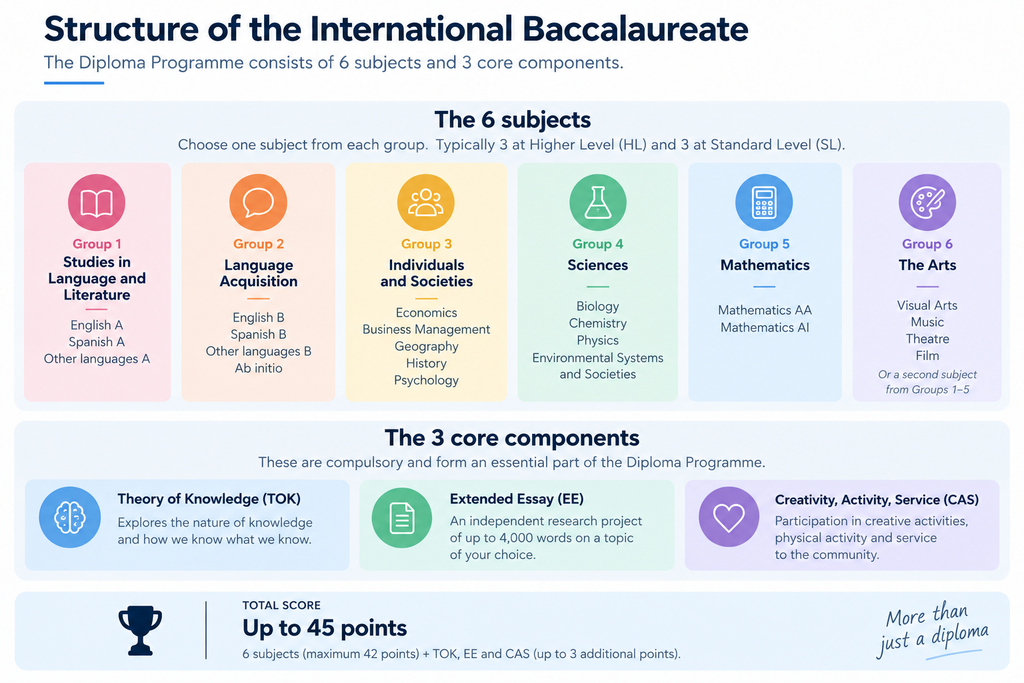
One of the defining features of the Diploma Programme is that students take six subjects, divided into six groups:
- Studies in Language and Literature
- Language Acquisition
- Individuals and Societies
- Sciences
- Mathematics
- The Arts
Students generally choose one subject from each group, although in certain cases, the Arts subject can be replaced by another subject.
For example, one student might take:
- English A
- Spanish B
- Economics
- Chemistry
- Mathematics AI
- Biology
while another may have a completely different combination.
Therefore, there is no single IB timetable or subject combination.
What do SL and HL mean?
This is probably one of the first things you’ll hear when you start the IB:
SL = Standard Level
HL = Higher Level
Of the six subjects, students take three at Higher Level and three at Standard Level.
HL subjects are studied in greater depth and generally involve a greater amount of content and teaching hours.
This does not mean that SL subjects are “easy” or that HL subjects are simply a version with more topics.
What subjects should I choose at HL?
This decision is particularly important if you already know what degree you want to study at university.
For example, certain science-related degrees may require or recommend having taken specific subjects at HL.
Therefore, you should not choose subjects simply because they seem easier to get a good grade in.
Before choosing them, it is advisable to check:
- What degree you want to study.
- Which universities you are interested in.
- What admission requirements they have.
- Which subjects and levels they recommend or require.
How is the International Baccalaureate scored?
Here we find another important difference compared with other education systems.
Each of the six subjects is normally graded from 1 to 7:
| Grade | Interpretation |
|---|---|
| 7 | Excellent |
| 6 | Very good |
| 5 | Good |
| 4 | Satisfactory |
| 3 | Low |
| 2 | Very low |
| 1 | Minimal |
Therefore, the maximum score from the six subjects is:
6 × 7 = 42 points
But the Diploma Programme allows students to obtain up to 45 points.
Why?
Because, in addition to the six subjects, there are the core components of the programme.
What are TOK, CAS and the Extended Essay?
These three components form part of the core of the Diploma Programme and allow students to earn the additional 3 points towards their final IB score.
TOK — Theory of Knowledge
Theory of Knowledge (TOK) is a subject/component in which students reflect on questions related to knowledge.
It is not simply about memorising content.
The aim is to learn how to analyse questions such as:
- How do we know that something is true?
- What role does evidence play?
- How does our perspective influence us?
- What is the difference between an opinion and a well-supported claim?
TOK can seem quite strange at first precisely because it is not very similar to traditional subjects. It is assessed through an oral presentation and a 1,600-word essay, both of which challenge students to think critically and express their understanding of complex concepts.
Extended Essay
The Extended Essay (EE) is an independent research project that students carry out on a specific topic.
It has a maximum length of 4,000 words and requires students to formulate a research question, gather information, analyse it, and develop their own argument.
Although it is normally completed during Year 2, you should not think of it as a project to start just before the deadline.
Choosing a good topic and planning early can save you a huge amount of work later on.
CAS
Creativity, Activity, Service (CAS) is another compulsory component of the programme.
The idea is for students to take part in activities related to:
- Creativity
- Activity
- Service
It is not simply about accumulating hours by doing activities. CAS aims to encourage students to participate in experiences outside the purely academic environment and reflect on them. It does not receive a grade as such, but failing to meet the CAS requirements means that the student will not be awarded the Diploma.
How do IB exams work?
This is probably one of the biggest differences compared with other education systems.
Generally, a significant part of the final grade comes from external exams taken at the end of the programme, but exams are not necessarily the only form of assessment.
Depending on the subject, there may also be different internal assessment components, coursework, investigations, presentations, or projects.
This means that a student may find themselves in a situation quite different from what they expected:
“I can’t leave everything until April to study.”
And this is one of the main reasons why planning during Year 1 of the IB is so important.
What are Internal Assessments?
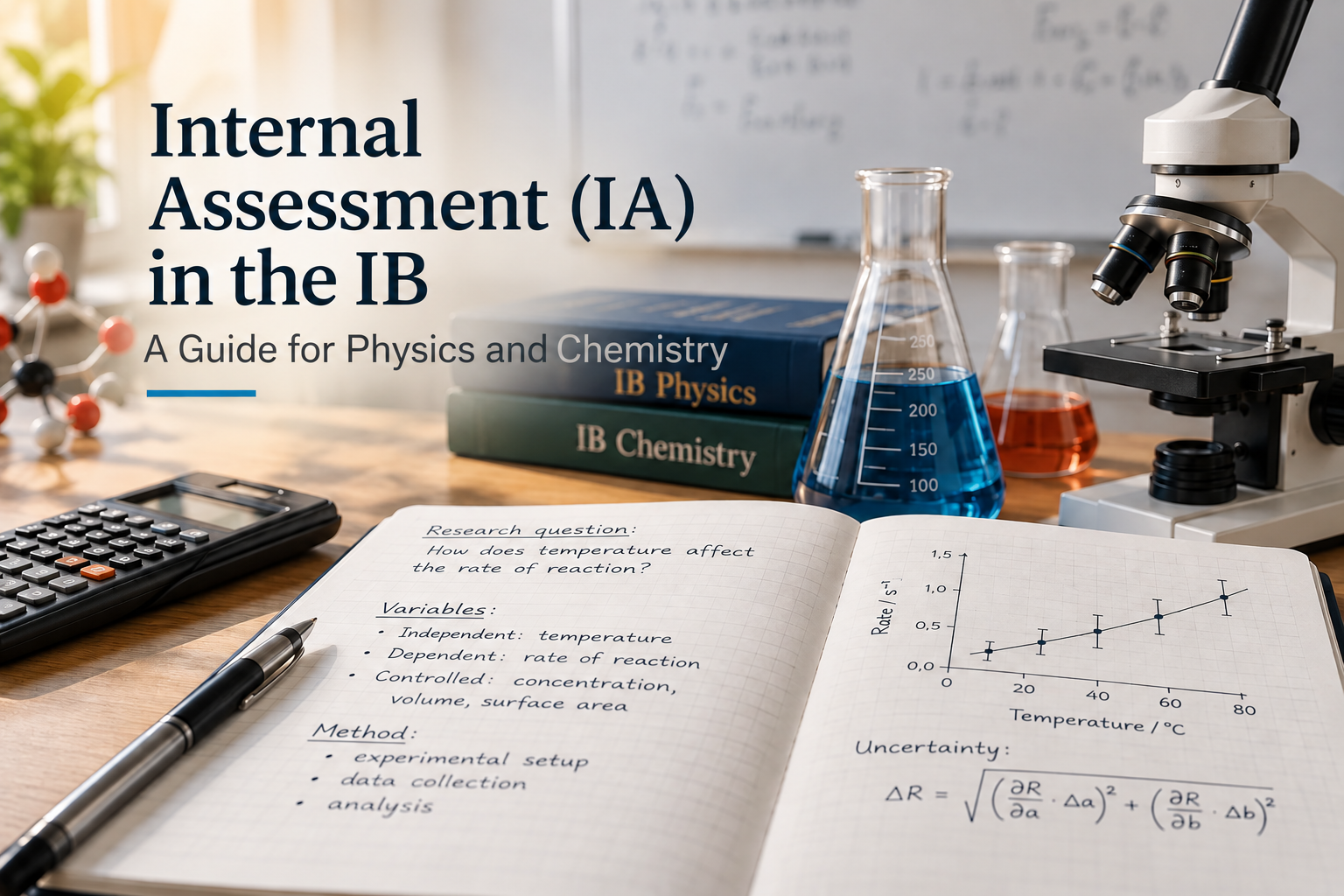
Internal Assessments (IAs) are assessment components completed during the programme and form part of the assessment of certain subjects.
Their format depends on the subject. In Sciences, for example, they involve carrying out a 3,000-word scientific investigation. The important thing to understand from the beginning is that IAs are not simply normal homework. They form part of your official assessment and can have a significant impact on your final grade. That is why it is important to take them seriously from the moment your teacher starts working on them.
What should I do during the first few months of Year 1 of the IB?
This is probably the most important part of the entire guide.
When you start the IB, it is very easy to make one mistake:
trying to study a huge amount from day one without having a system.
You do not need to study eight hours a day during September.
What you need is to build good habits.
1. Understand how each subject works
During the first few weeks, try to find out:
- What content you will study.
- How the subject is assessed.
- What assignments you will have to complete.
- How much weight each component carries.
- What types of questions appear in the exams.
This will allow you to study for the type of assessment you will actually have, rather than simply memorising the textbook.
2. Don’t let knowledge gaps build up
This is probably one of the best pieces of advice I can give you for Year 1 of the IB.
If you do not understand a concept in Maths or Chemistry in October and decide to leave it for later, by December you will probably have several concepts that depend on it.
And then catching up becomes much more difficult.
A small question resolved this week can save you several hours of work two months from now.
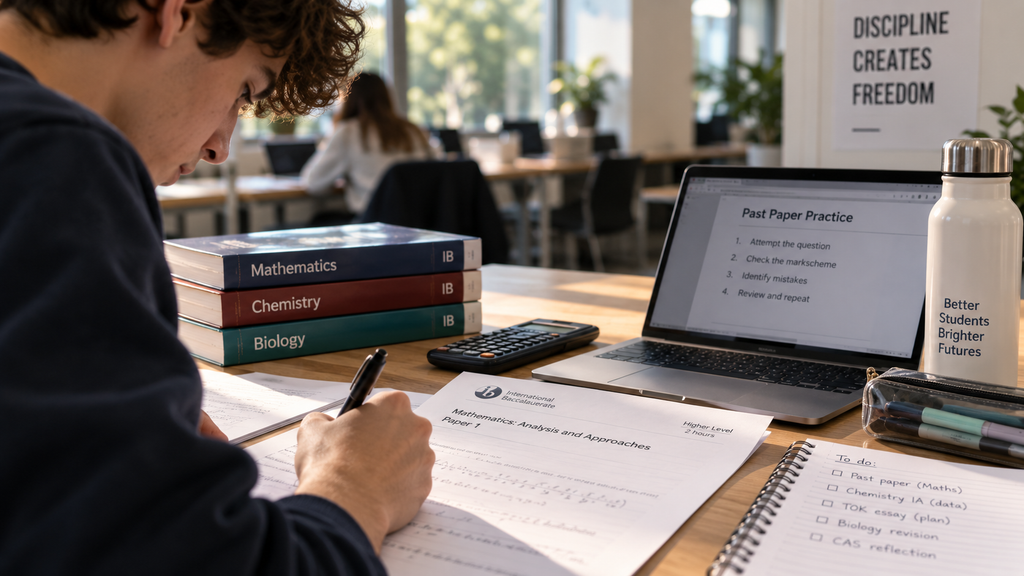
3. Start practising exam questions
Studying the theory is necessary, but not enough.
In the IB, it is very important to get used to how questions are phrased and what the examiner expects in your answers.
That is why, progressively, you should start working with:
- Exam questions.
- Markschemes.
- Past papers.
- Exercises specific to the type of assessment in your subject.
Especially in subjects such as Mathematics and Sciences, doing exercises is a fundamental part of learning.
4. Don’t leave your IAs until the last minute
When you are still in September or October of Year 1, it may seem like the Internal Assessments are a long way off.
But the year goes quickly.
If you work on them progressively, you will have much more time to:
- Change an idea that does not work.
- Improve your methodology.
- Analyse your results.
- Correct mistakes.
- Review your writing.
Trying to do everything at the end often turns a manageable task into a huge source of stress.
5. Start thinking about the Extended Essay early
You do not necessarily need to decide on your final topic as soon as you start Year 1.
But it is a good idea to start thinking about which subjects interest you.
If there is a subject you particularly enjoy, ask yourself:
Is there a specific question I would like to investigate in depth?
A good research question can make the EE much more interesting and manageable.

Is the International Baccalaureate difficult?
This is probably one of the questions students ask most before starting.
The honest answer is:
yes, it can be demanding, but the difficulty is not simply about the amount of content.
The IB requires you to combine:
- Knowledge.
- Understanding.
- Application.
- Analytical skills.
- Organisation.
- Time management.
- Independent work.
Therefore, a student who is used to getting good grades by studying only a few days before an exam may find the IB challenging.
On the other hand, a student who learns to work consistently and in an organised way can adapt perfectly well to the system.
So, how should I organise myself in Year 1 of the IB?
You do not need to have a perfect plan from day one.
A reasonable strategy could be:
During the first few weeks:
→ Understand the programme and familiarise yourself with each subject.
During the first term:
→ Build a study routine and identify your weak areas. Don’t get frustrated if your initial grades are not what you expected. It is normal to need a period of adjustment to the system, the way questions are answered, etc.
During the rest of Year 1:
→ Consolidate content, practise questions, and progressively work on your IAs.
Before finishing Year 1:
→ Try to enter Year 2 with a solid foundation and no major knowledge gaps. Ideally, use the summer to get all your IAs underway.
The goal is not to study constantly.
The goal is to avoid letting work pile up.
One final piece of advice for starting the IB
If you have just started Year 1 of the International Baccalaureate, you probably feel that there are too many things to keep track of right now.
That is completely normal.
You do not need to know how to do everything from the beginning.
During the first few weeks, focus on three things:
Understand the system → get organised → work consistently.
The IB becomes much more manageable when you stop seeing it as one huge set of tasks and start breaking it down into smaller parts.
And, above all, don’t wait until you are completely lost before asking for help. A specific question about Mathematics, Chemistry, or any other subject is much easier to solve when it first comes up than after several weeks of accumulating content you do not understand.
Do you need help with the International Baccalaureate?
If you are starting Year 1 of the IB and need support with Mathematics, Chemistry, Biology, or Physics, tutoring can help you consolidate the content from the beginning and, above all, become familiar with the types of exercises and assessments used in the programme.
If you would like to discuss your situation and design a personalised study plan, you can book a first consultation.