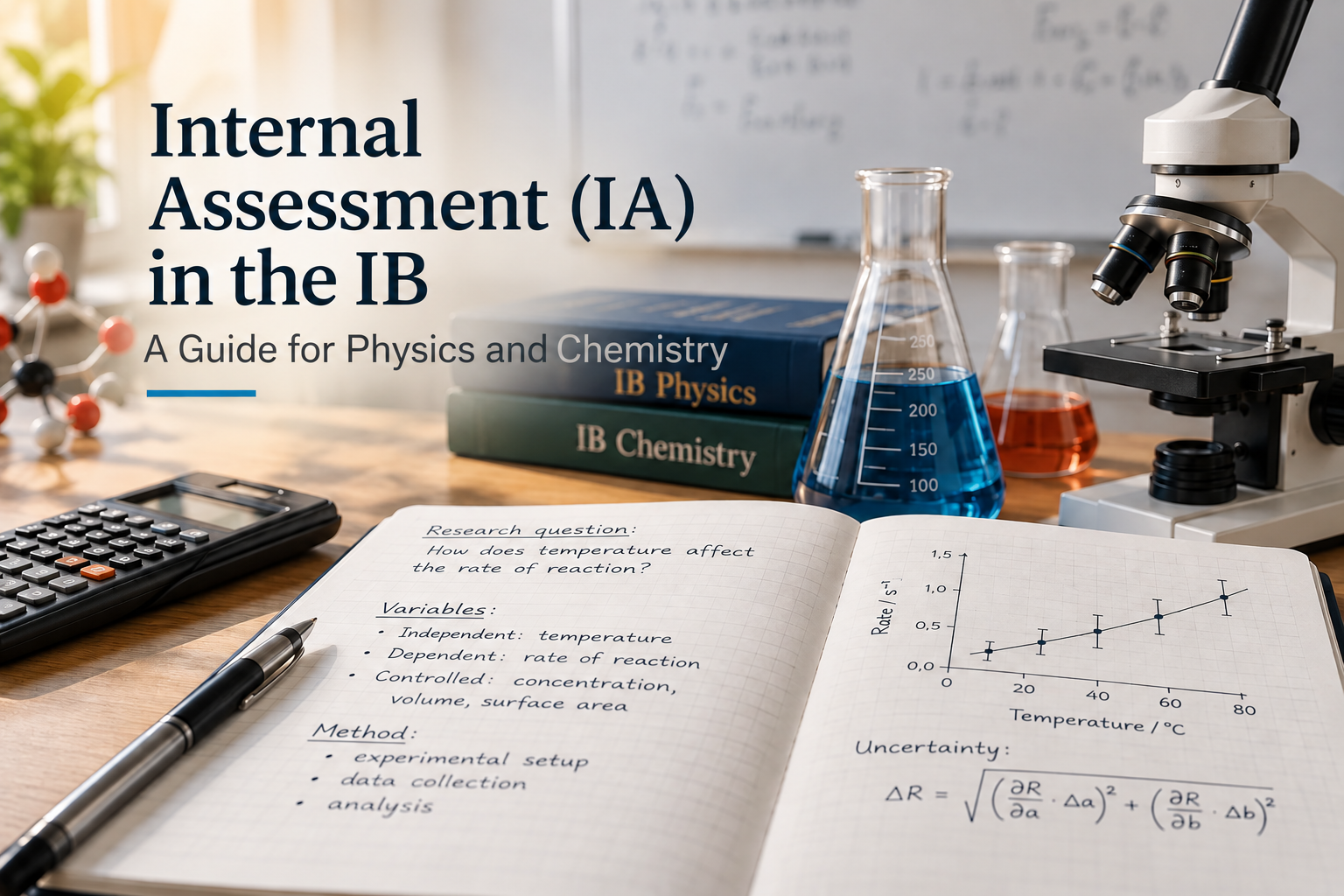
If you are studying the International Baccalaureate (IB), sooner or later you will probably have to complete an Internal Assessment (IA). In science subjects such as Physics and Chemistry, the IA is an opportunity to carry out your own investigation and demonstrate that you can apply the concepts and tools from the subject to a specific problem.
However, a good IA is not simply about carrying out an experiment and writing a report. Choosing the right research question, designing the experiment, processing the data and evaluating the results are all fundamental parts of the process.
In this guide, we will look at how to approach a science IA in the IB, the most common mistakes students make, and what you can do to develop a strong analysis.
What is the Internal Assessment in IB Physics or Chemistry?
The Internal Assessment is part of the internal assessment component of certain IB subjects. In Physics and Chemistry, it involves carrying out an individual scientific investigation related to the content and methods of the subject.
The aim is not simply to demonstrate that you can follow an experimental procedure. You need to show that you can:
- design an appropriate investigation;
- collect and process data;
- use scientific concepts to analyse it;
- interpret your results;
- evaluate the limitations of your method;
- and draw conclusions supported by your evidence.
For this reason, a science IA should be approached as a scientific investigation, rather than simply as an extended laboratory report.
The first step: choosing a good research question
One of the most important parts of the IA happens before you even start collecting data.
A good investigation needs a specific and feasible research question.
A question that is too broad makes it difficult to carry out a meaningful analysis. For example:
How does temperature affect a chemical reaction?
is too general.
A more specific question could be:
How does temperature affect the rate of reaction between sodium thiosulfate and hydrochloric acid?
The second question makes it much easier to identify what you are changing, what you are measuring and what relationship you want to investigate.
The same applies to Physics.
How does the length of a pendulum affect its period?
is a much more manageable investigation than a broad question about how pendulums work.
A good research question needs to be feasible
Before committing to a research question, ask yourself:
- Can I carry out this investigation with the equipment available?
- Can I collect enough data?
- Can I control the relevant variables?
- Do I have enough scientific and mathematical knowledge to analyse the results?
- Can the relationship between the variables be studied quantitatively?
- Will I be able to carry out a meaningful evaluation?
A question can be scientifically interesting while still being a poor choice for an IA if it cannot be investigated properly.
Don’t choose the experiment first and find a question afterwards
This is a common mistake.
A student finds an interesting experiment and thinks:
“I’ll do this and then work out what I can investigate.”
The problem is that you may end up with an experiment that produces data but does not allow you to carry out a sufficiently deep analysis.
It is better to start with the relationship you want to investigate and then design a method that allows you to study it.
For example, if you want to investigate how one variable affects another, you should think about the following from the beginning:
- which values you are going to use;
- how many measurements you need;
- which variables need to be controlled;
- how precise your instruments are;
- and what mathematical analysis you will carry out afterwards.
Designing the experiment correctly
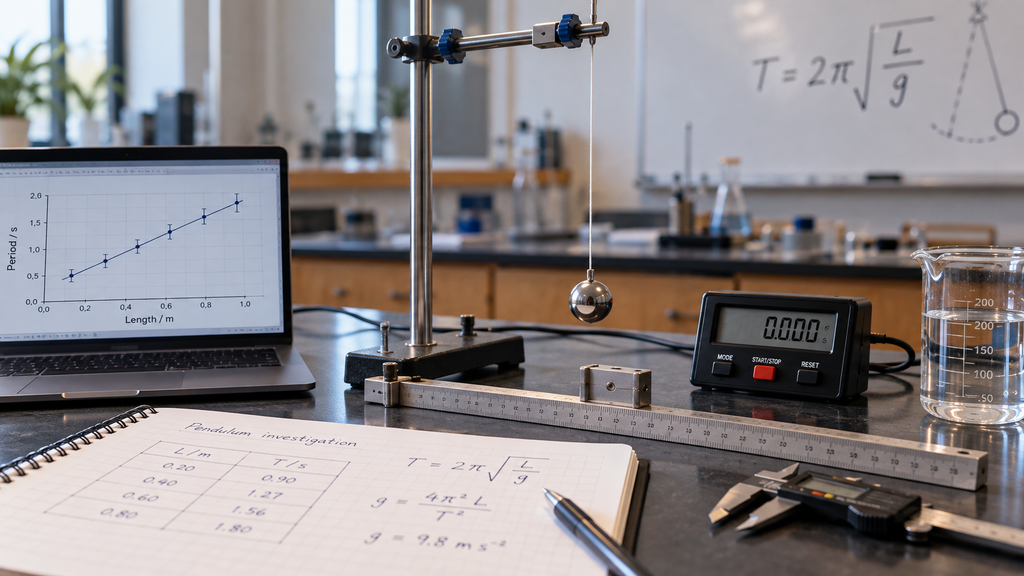
Once you have a feasible research question, you need to design your investigation.
A good experimental design should clearly identify:
Independent variable
The variable that you deliberately change.
For example:
- temperature;
- length;
- concentration;
- mass;
- voltage;
- distance.
Dependent variable
The variable that you measure.
For example:
- time;
- velocity;
- period;
- absorbance;
- temperature;
- current.
Controlled variables
Variables that could affect the result and that you try to keep constant.
This is particularly important because if several variables change at the same time, it becomes difficult to determine what is causing the observed changes.
Collecting data is not enough
A science IA needs data that allows you to carry out a meaningful analysis.
Before starting the experiment, think about what data you will actually need to answer your research question.
In general, it is useful to have several values of the independent variable and repeated measurements where appropriate.
For example, if you are investigating a relationship between two variables, five data points may allow you to observe a trend, but a wider range and enough measurements can give you many more opportunities to analyse the behaviour of the relationship.
Repeating measurements can also help you identify:
- experimental variation;
- anomalous values;
- data spread;
- uncertainties;
- and the consistency of your results.
Uncertainties are an important part of the analysis
One of the things that distinguishes a strong scientific analysis from a superficial one is the treatment of uncertainties.
It is not enough to simply record your measurements.
You should consider the precision of your instruments and how uncertainties affect your results.
Depending on your investigation, this may involve:
- absolute uncertainties;
- relative or percentage uncertainties;
- propagation of uncertainties;
- error bars;
- and comparison of uncertainties between results.
For example, if two results appear to be different but their uncertainties overlap considerably, you cannot necessarily conclude that there is a significant difference.
Uncertainty should be used to interpret your data, rather than simply appearing as an additional number in your tables.
A graph is not just decoration
Another common mistake is including a graph because “you need to have a graph”.
A graph should help you analyse the relationship between the variables.
Depending on the investigation, you may want to study:
- the gradient;
- the intercept;
- linearity;
- correlation;
- the shape of the curve;
- possible deviations;
- or how well the data fits a theoretical model.
In some cases, a mathematical transformation of the data can allow you to test whether a particular relationship is consistent with a linear model.
For example, a relationship that initially appears curved may become linear after transforming one or both variables.
This can take your analysis much further than simply stating:
“The graph shows a positive relationship.”
Compare your results with a scientific model
A Physics or Chemistry investigation should not simply describe the data.
Where possible, you should relate your results to the scientific theory or model you are studying.
Ask yourself:
- Are the results consistent with the theory?
- Does the observed relationship have the expected form?
- Does the gradient have a physical or chemical meaning?
- Is the experimental value consistent with the theoretical value?
- Can differences be explained by the uncertainties?
- Is there any unexpected behaviour?
This connection between experimental data and the theoretical model is often much more valuable than simply presenting the results.
A good evaluation is not a list of errors
Evaluation is another area where many students miss opportunities.
A weak evaluation might say:
“A more precise instrument could be used.”
The problem is that this does not explain why that limitation matters.
A stronger evaluation should explain:
- what the limitation is;
- how it affects the results;
- what evidence allows you to identify it;
- and how the method could be improved.
For example, if human reaction time affects an experimental measurement, it is not enough to say that “reaction time introduces error”.
You should explain how this error may affect the data and what procedure could reduce its impact.
Not all sources of error are equally important
Another common mistake is producing a long list of possible sources of error.
You do not need to prove that the experiment is imperfect. All real experiments have limitations.
What matters is identifying the limitations that can actually affect your conclusion.
Instead of listing ten generic sources of error, it is usually more useful to analyse two or three relevant limitations in depth.
How long should an IA be?
There is no direct relationship between the quality of an IA and its number of pages. The 3,000-word limit means that you need to be concise and direct, while making sure that your work addresses the assessment criteria. The important thing is that each section contributes to answering the research question.
As for the time needed to produce a good piece of work, it is estimated that a student should dedicate around 40 hours to completing the IA, taking into account the preparation and execution of the experiment, data analysis and writing.
Common mistakes in a science IA
Before submitting your investigation, pay particular attention to these points:
1. The research question is too broad
If you cannot clearly explain which variables you are studying, you probably need to make your question more specific.
2. The experiment does not actually answer the question
Sometimes students collect a lot of data, but that data does not allow them to directly answer the research question they have proposed.
3. There is too much data and not enough analysis
A large table does not replace scientific interpretation.
4. Uncertainties are included but not used
Calculating an uncertainty is not very useful if you never consider it when interpreting your results.
5. The graph is not interpreted
It is not enough to include a trendline and mention the value of . You need to explain what it means and what information it provides about your investigation.
6. The evaluation is generic
Saying that “using more precise equipment would improve the experiment” is not enough. Explain which source of uncertainty would be reduced and how this would affect your results.
7. You try to fill pages
The goal is not to produce the longest report possible. The goal is to build a clear, coherent and scientifically justified investigation.
When should you start your IA?
Don’t wait until the final weeks of the course. Ideally, you should make significant progress on your IAs before starting your second year of the IB.
The best time to start thinking about your IA is while you still have enough time to change your research question, repeat an experiment or improve your experimental design.
A good process could look like this:
Idea → research question → experimental design → data collection → processing → analysis → evaluation → conclusion
If you discover a problem during one of the early stages, you still have time to fix it.
If you discover it a few days before the deadline, your options will be much more limited.

In summary
A good Physics or Chemistry IA is not about carrying out a complicated experiment or writing a large number of pages.
It is about building an investigation in which there is a clear connection between:
Research question → method → data → analysis → conclusion → evaluation
Before you start, make sure that your research question is specific enough and that you can actually investigate it with the resources available.
During the experiment, think about the quality of your data and your uncertainties.
And during the analysis, try to go beyond describing what happens: use your data to explain the relationship between the variables and how far your results are consistent with the scientific model.
If you are preparing an IB Physics or Chemistry IA and have questions about your research question, experimental design or data analysis, I can help you review your approach and identify potential problems before you get too far into your investigation.
The goal is not to do the IA for you, but to help you understand what you are doing and why.